

Your Car Isn't Worth What You Think: Why Replacement Cost vs. What You Owe Is the #1 Way People Get Burned After a Total Loss
You've worked hard to buy your vehicle. You make your payments. You maintain your coverage.
But if your car is totaled tomorrow, your insurance payout may not be enough to buy the same vehicle again. It may not even be enough to pay off your loan.
That is where many drivers get burned.
The issue usually comes down to three different numbers:
What your car is worth today
What it costs to replace your car today
What you still owe your lender
Those numbers can be very different. Understanding the difference can help you avoid a painful financial surprise.
The Number Most Standard Auto Policies Use: Actual Cash Value
Most standard auto insurance policies settle a totaled vehicle based on Actual Cash Value, or ACV.
ACV is your vehicle's estimated market value immediately before the loss. It accounts for factors such as:
Age
Mileage
Condition
Vehicle options
Accident history
Local market prices
Depreciation
In simple terms, ACV is what your car is worth today: not what you paid for it and not what a replacement costs today.
Your insurer generally determines ACV using a valuation process that compares your vehicle with similar vehicles in your area. If you disagree with the valuation, you may be able to provide evidence of your car's options, condition, maintenance, and comparable listings.
Kelley Blue Book explains that ACV reflects what you could reasonably expect to receive if you sold your vehicle in its current condition today. You can review its explanation of Actual Cash Value for car insurance.
Depreciation Changes Everything
A vehicle begins losing value as soon as you drive it away from the dealership. It can continue depreciating quickly during the first few years.
That means a vehicle you purchased for $35,000 may not have a $35,000 insurance value months later. If it is totaled, the insurer may base the settlement on its depreciated market value.
You paid for a newer vehicle. Your policy may value it as a used vehicle.
That difference creates the first major gap.
Replacement Cost Is a Different Calculation
Replacement Cost Value, or RCV, focuses on what it costs to replace your vehicle without subtracting depreciation.
The concept is straightforward:
ACV: Replacement cost minus depreciation
RCV: Cost to replace the vehicle without depreciation
For many types of insurance, replacement cost coverage is more familiar on homeowners or renters policies. For example, replacement cost coverage for personal belongings may help you replace an older item with a new, comparable item after a covered loss.
Auto insurance works differently. Standard auto policies usually use ACV for a total-loss settlement. Some carriers offer an optional new car replacement endorsement or similar coverage for eligible vehicles.
Progressive provides a helpful overview of replacement cost versus actual cash value.
New Car Replacement Coverage Can Reduce the Depreciation Problem
A new car replacement endorsement is designed to protect you from the steepest part of early vehicle depreciation.
If your eligible vehicle is totaled, the endorsement may pay for a brand-new vehicle of the same make and model, rather than paying only the vehicle's depreciated ACV.
However, this coverage is not automatically included. It also comes with eligibility requirements and limits.
Your vehicle may need to meet conditions involving:
Vehicle age
Mileage
Original ownership
Purchase date
Whether the vehicle was previously titled
The length of time you have owned it
Availability of the same make and model
Some endorsements apply only to vehicles that are a few years old or newer. Some may offer a comparable vehicle or an additional amount above ACV instead of a brand-new same-make/model replacement.
The name of the coverage is not enough. The details matter.
Ask these questions before you rely on new car replacement coverage:
✔ Is my vehicle eligible today?
✔ How long does eligibility last?
✔ Is the replacement required to be the same make and model?
✔ Does the coverage include taxes, title fees, and registration?
✔ Does the endorsement replace the vehicle or add a percentage to the ACV settlement?
✔ What exclusions or mileage limits apply?
If you recently purchased a vehicle, this is a good time to review your policy. Do not wait until after a total loss to find out whether the endorsement applies.
The Loan Problem: What You Owe May Be More Than ACV
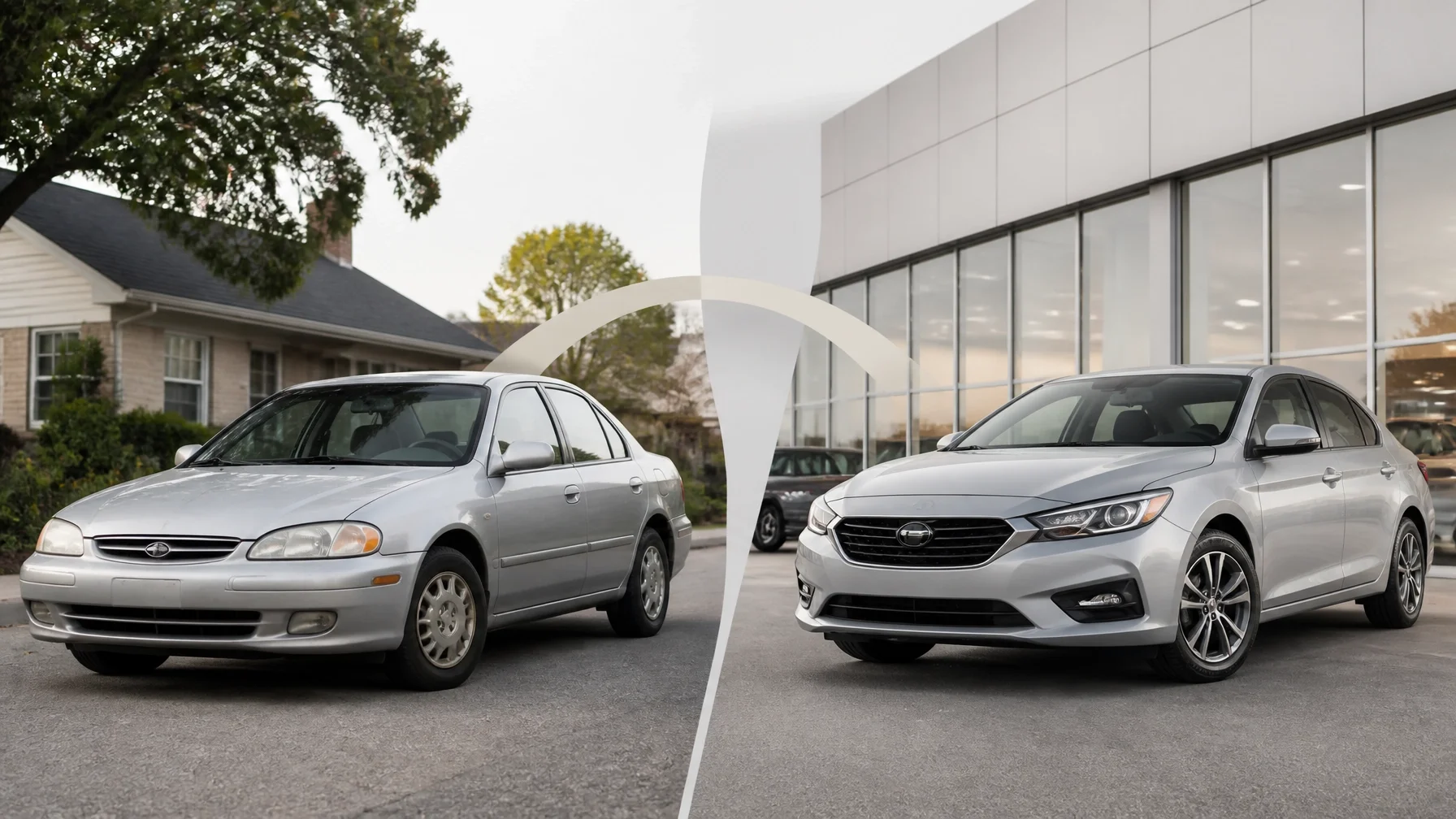
Your lender does not care what your car is worth after an accident. Your lender cares about the remaining loan balance.
Your insurance company also does not automatically pay whatever you owe. It generally pays the covered vehicle's ACV, minus any applicable deductible and subject to the policy terms.
If your loan balance is higher than the insurance settlement, you may still owe the difference.
This situation is often called being upside down or underwater on your auto loan.
How Does the Gap Happen So Fast?
You can become upside down even when your payments are current. Several factors can create the gap:
Your vehicle depreciates immediately after purchase.
You make a small down payment.
You finance taxes, fees, warranties, or other products.
You roll negative equity from an older vehicle into the new loan.
Interest accumulates over the life of the loan.
You choose a longer loan term.
Vehicle values decline faster than expected.
The result is simple. Your loan balance may decrease slowly while your vehicle's market value falls quickly.
A $6,000 Gap You May Have to Pay
Consider this example:
You still owe $28,000 on your auto loan.
Your insurer determines that your vehicle's ACV is $22,000.
Your vehicle is declared a total loss.
You do not have gap insurance.
The calculation looks like this:
Without gap coverage, you may be responsible for the $6,000 difference.
You could owe that money even though you no longer have the vehicle. You may also need to find money for a down payment on your next car.
A totaled vehicle can leave you with two financial obligations: the old loan and the replacement vehicle.
Gap Insurance Protects the Loan Balance
Gap insurance addresses a different problem than replacement cost coverage.
New car replacement coverage protects the value of the vehicle. Gap insurance protects the loan or lease balance.
If your insurer pays $22,000 and you owe $28,000, gap coverage may help pay the $6,000 difference to your lender, subject to the policy's terms and exclusions.
Gap insurance may not cover every amount connected to your loan. Policies can vary regarding:
Deductibles
Late payments
Interest
Rolled-over negative equity
Extended warranties
Other financed products
Loan fees or penalties
Review the actual contract. Do not assume every gap policy works the same way.
You can also review Kelley Blue Book's explanation of how gap insurance helps with an upside-down auto loan.
ACV, New Car Replacement, and Gap Insurance Compared
The right combination depends on your vehicle, loan, budget, and policy availability.
You may need gap insurance. You may qualify for new car replacement. You may need both. Or you may have enough equity in your vehicle that gap coverage is no longer necessary.
How to Protect Yourself Before a Total Loss
You do not need to predict an accident. You need to understand your coverage before one happens.
1. Ask About Gap Insurance
If you financed your vehicle with a small down payment, chose a long loan term, or rolled another balance into the loan, ask whether gap coverage makes sense.
Your need may decrease as you build equity. Review it periodically.
2. Ask About New Car Replacement
If your vehicle is newer, ask whether you qualify for a new car replacement endorsement.
Confirm the age, mileage, ownership, and replacement requirements. These details can change your protection significantly.
3. Check Your Deductibles
A higher deductible may lower your premium. It also increases what you pay after a covered loss.
Make sure your deductible fits your emergency fund. Your total-loss settlement may be reduced by that amount.
4. Review Your Policy Every Year
Your vehicle changes. Your loan balance changes. Your household changes.
Review your auto insurance at least annually and after major events such as:
✔ Buying or selling a vehicle
✔ Refinancing an auto loan
✔ Adding a teen driver
✔ Moving to a new state or ZIP code
✔ Changing your commute
✔ Paying off a loan
✔ Adding another vehicle
An annual review can also help you coordinate your auto coverage with your broader personal insurance plan, including home, renters, umbrella, life, and final expense coverage. Your car is only one part of the protection you've built for yourself and your family.
You can learn more about coordinating personal coverage in our guide to the four pillars of personal insurance.
Protect the Car You Have: and the Financial Plan Behind It
A total loss is already disruptive. You should not also discover that you owe thousands on a vehicle you can no longer drive.
ACV protects the depreciated market value. New car replacement can protect against depreciation. Gap insurance can protect the loan balance.
Those coverages solve different problems. Understanding the difference helps you make a more informed decision.
You've invested in your vehicle. You've built your household budget around your transportation. Take a few minutes to confirm that your coverage matches your current vehicle and loan.
Talk With Shady Oak Insurance Agency
Do you know what your insurer would pay if your car were totaled today? Do you know what you would still owe after that payment?
Shady Oak Insurance Agency can review your policy and help you identify potential exposure involving:
✔ Actual Cash Value settlements
✔ New car replacement eligibility
✔ Gap insurance needs
✔ Deductibles
✔ Loan and lease balances
✔ Auto, home, renters, and umbrella coordination
Call Shady Oak Insurance Agency at 612-361-9717 for a policy review. A clear conversation today can help you avoid a very expensive surprise later.
Coverage availability, eligibility, limits, deductibles, and exclusions vary by insurer and policy. This article is for general educational purposes and does not change the terms of your insurance contract.
