

The Accident Playbook: A Step-by-Step Guide to What to Do (and Not Say) After a Crash

A crash can turn an ordinary drive into a stressful, confusing situation. You may feel shaken. You may not know what to say, what to document, or who to call first.
You do not need to handle the moment perfectly. You need a clear plan.
This accident playbook gives you the steps to follow after a crash, and the mistakes to avoid. Save it now so you can find it when you need it.
> Important: This guide provides general information. Your policy terms, state requirements, and circumstances may affect what you should do. When in doubt, contact your insurance professional or qualified legal counsel.
Before Anything Else: Protect People, Not Property
Your first priority is safety.
1. Check for injuries and call 911
Check yourself, your passengers, and the people in the other vehicle. If anyone is injured, trapped, unconscious, or in immediate danger, call 911 right away.
Tell the dispatcher:
Your exact location
The number of vehicles involved
Whether anyone appears injured
Whether traffic or fire creates an additional hazard
Do not attempt to move someone who may have a serious injury unless there is an immediate life-threatening danger.
If the crash is minor and your vehicle is drivable, move it to a safe location when you can do so safely and lawfully. Turn on your hazard lights. Stay away from moving traffic.
Why does moving matter? A disabled vehicle in an active lane can create another collision. Safety comes first.
Document the Scene Before Details Disappear
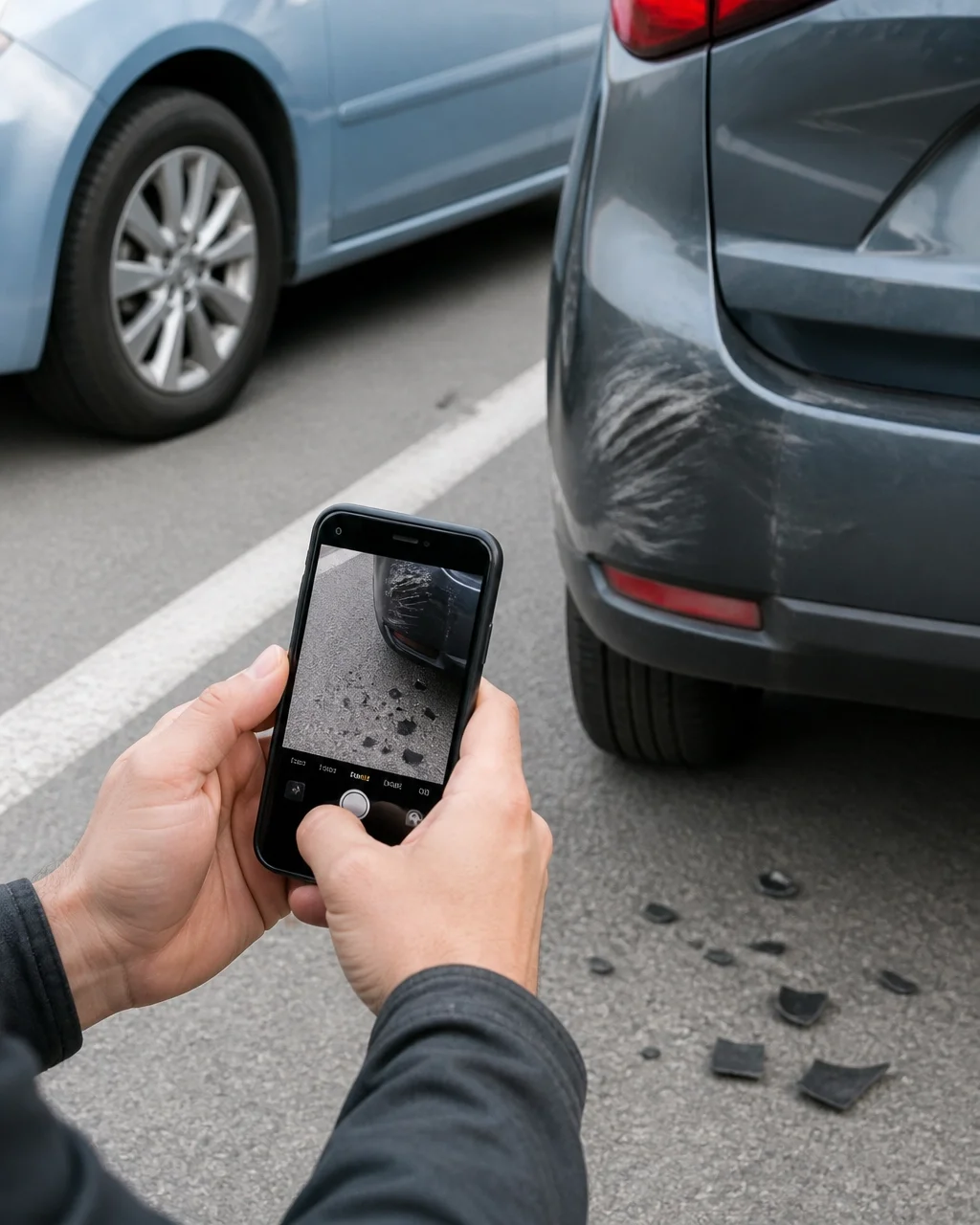
Once everyone is safe, document what you can. Take photos before vehicles are moved whenever possible. If you already moved to a safer location, photograph the damage and return to scene details only if it is safe.
2. Photograph the accident scene
Use your phone to capture a broad record. Take more photos than you think you need.
Photograph:
Damage to every involved vehicle
Close-ups and wide-angle views of your vehicle
License plates
Vehicle positions, if they remain unchanged
Road signs, traffic lights, and lane markings
Road conditions, including ice, standing water, potholes, or gravel
Debris, skid marks, and damaged property
Weather, visibility, and lighting conditions
Any visible injuries, if appropriate
Avoid stepping into traffic to get a better angle. Your safety matters more than one additional photograph.
You can also write down the time, location, direction of travel, and a brief factual description of what happened. Do not embellish. Do not guess. Record what you observed.
Exchange Information Without Arguing
3. Collect information from every driver and witness
Remain calm and courteous. You do not need to debate who caused the crash at the scene. You need accurate information.
Exchange the following with each driver:
Full name
Phone number and address
Driver’s license information
Vehicle year, make, model, and color
License plate number
Insurance company and policy number
Registered owner’s information, if different from the driver
Look for witnesses. Ask for their names and phone numbers. If someone is willing to describe what they saw, record a short note in your phone. Do not pressure anyone to take sides.
If the other driver refuses to share information, appears impaired, becomes aggressive, or leaves the scene, move to safety and tell the police.
Get the Police Report Number
4. Ask how to obtain the report
A police report can provide an official record of the crash. Depending on your location and the circumstances, officers may respond to crashes involving injuries, significant damage, unsafe conditions, suspected impairment, or disputes between drivers.
When the police arrive:
Provide your license, registration, and insurance information
Describe what happened using factual, neutral language
Avoid guessing about speed, distance, or fault
Ask for the officer’s name and badge number
Ask how to obtain the report
Write down the police report number
Your insurance company may request the report during the claim process. A report number can also make it easier to track the report later.
Requirements differ by state. You can review general post-crash guidance from Progressive or Allstate, then confirm local requirements with your state authorities.
Take Your Health Seriously After the Crash
5. See a doctor within 24–72 hours, even if you feel fine
Adrenaline can mask pain after a crash. Symptoms may not appear until later. Whiplash, soft-tissue injuries, concussions, and other conditions can develop gradually.
Schedule medical care within 24 to 72 hours, even if you initially feel fine. Seek emergency care sooner if you have severe pain, confusion, weakness, numbness, difficulty breathing, loss of consciousness, or other concerning symptoms.
Tell the medical provider that you were involved in a crash. Follow their instructions and keep every related record, including:
Emergency room or urgent care records
Doctor’s notes
Imaging results
Prescriptions
Physical therapy records
Medical bills
Receipts for transportation or other care
Do not minimize your symptoms by saying you are “fine” if you are still assessing how you feel. Be accurate and complete with your doctor.
Notify Your Own Insurer Promptly
6. Report the accident using facts only
Contact your insurance company or insurance agent as soon as reasonably possible. Many policies require prompt notice after an accident.
When you report the claim, be ready to provide:
Date, time, and location
Names and contact details of the other drivers
Insurance information
Police report number
Photos and documentation
A basic description of the crash
Information about injuries or medical care
Stick to what you know. Explain what you observed. Do not speculate about fault or fill gaps in your memory with assumptions.
Your own insurer can explain available coverage, including collision coverage, rental reimbursement, medical payments coverage, uninsured or underinsured motorist coverage, and the claims process. Your policy controls what applies.
What about a recorded statement?
You may need to cooperate with your own insurer under the terms of your policy. Ask when the statement is needed, gather your notes, and answer truthfully.
You generally do not have to provide a recorded statement to the other driver’s insurance company simply because they request one. Before giving a recorded statement to another insurer, especially if you have injuries or fault is disputed, consider speaking with a qualified attorney.
Track Every Expense
7. Create a claim folder
Small expenses can add up quickly after a crash. Keep one physical or digital folder for every document.
Track:
Medical bills and receipts
Prescription costs
Vehicle repair estimates
Towing and storage fees
Rental vehicle costs
Rideshare or transportation expenses
Lost wages
Childcare or household help related to the crash
Other reasonable, accident-related expenses
Write down dates and keep copies of everything you submit. Ask your employer for documentation if you miss work.
A complete record helps you understand the financial impact of the crash. It also helps your insurer evaluate the claim more efficiently.
What Not to Say or Do After a Crash
The wrong comment or decision can complicate an otherwise manageable claim. Keep these rules in mind.
Do not admit fault or apologize
Do not say:
“It was my fault.”
“I should have seen you.”
“I’m sorry.”
“I caused this.”
Even a well-intended apology can be interpreted as an admission. You can be courteous without accepting blame. Say, “Let’s exchange information and allow the insurers to investigate.”
Do not speculate
Do not guess about:
How fast either vehicle was traveling
How far away another vehicle was
Whether you were distracted
What another driver saw
What caused the crash
If you do not know, say, “I’m not sure.” If you do not remember, say, “I don’t remember.” Accurate uncertainty is better than an inaccurate answer.
Do not say, “I’m fine”
You may feel fine because of shock or adrenaline. Instead, say, “I’m assessing how I feel and will seek medical care if needed.”
Then follow through with a medical evaluation within 24–72 hours.
Do not give the other driver’s insurer a recorded statement automatically
The other insurer may contact you quickly. You can provide basic claim information, but do not assume you must give a recorded statement.
Ask whether the request is required. If you have injuries, significant property damage, or a disagreement about fault, seek professional advice before proceeding.
Do not post about the crash on social media
Avoid posting:
Photos of the crash
Comments about fault
Updates about your injuries
Statements about your health
Settlement discussions
Opinions about the other driver
Even an innocent post can be taken out of context. Keep the details private while your claim is being evaluated.
Do not accept a quick, low settlement
An early settlement offer may arrive before you know the full cost of repairs, treatment, lost wages, or long-term injuries.
Do not sign a release or accept a final settlement before you understand:
What the payment covers
Whether future medical expenses are included
Whether property damage is resolved
Whether you can pursue additional compensation later
Once you sign certain documents, you may not be able to reopen the claim.
Prepare Before the Crash Happens
You cannot predict every accident. You can prepare for the paperwork, coverage questions, and decisions that follow.
Your auto policy should reflect your vehicle, driving habits, household, assets, and financial priorities. Review your deductibles, liability limits, collision and comprehensive coverage, rental reimbursement, uninsured or underinsured motorist coverage, and any available discounts.
You can also review Shady Oak Insurance Agency’s personal insurance guide for a broader look at how your auto, home, renters, umbrella, and other personal coverage can work together.
Protect Yourself Before You Need Protection
The best time to review your auto insurance is before the crash: not from the side of the road afterward.
You have worked hard to build your income, savings, transportation, and family security. Proper coverage helps protect what you have built when the unexpected happens.
✔ Review your liability limits
✔ Confirm your collision and comprehensive coverage
✔ Check whether rental reimbursement fits your needs
✔ Understand your uninsured and underinsured motorist protection
✔ Confirm who is covered to drive your vehicles
✔ Keep your insurance cards and emergency contacts accessible
Want to know whether your policy is ready for the unexpected? Call Shady Oak Insurance Agency at 612-361-9717 for a straightforward policy review.
You do not need to wait for a crash to discover a coverage gap. Prepare now. Protect what you have built.
